Architects of the Last Mile: The Human Factor in the AI Revolution
RW BECKOM ENTERPRISES INC.
Business Intelligence | Human Systems | AI Strategy
Why entry-level Business Analysts are not being replaced by AI—they are being repositioned for higher-value work.
By RW Beckom
Strategic insight on AI, business analysis, and the human edge in modern decision systems.
Artificial intelligence is changing the business landscape fast. Reports are drafted in seconds. Data is cleaned faster. Patterns surface earlier. Recommendations arrive before some teams have even aligned on the question.
For many entry-level Business Analysts, that shift creates a real tension.
If AI can do the analysis, what is left for the analyst?
A lot.
The market is not deleting the Business Analyst role. It is redefining it. AI is increasingly handling the how—the repetitive, procedural, and time-intensive execution. But the Business Analyst still owns the deeper layer: the why, the whether, and the should.
That is where the real leverage is.
And that is why the future of Business Analysis belongs to those who can operate in the last mile.
The Real Shift: From Execution to Orchestration
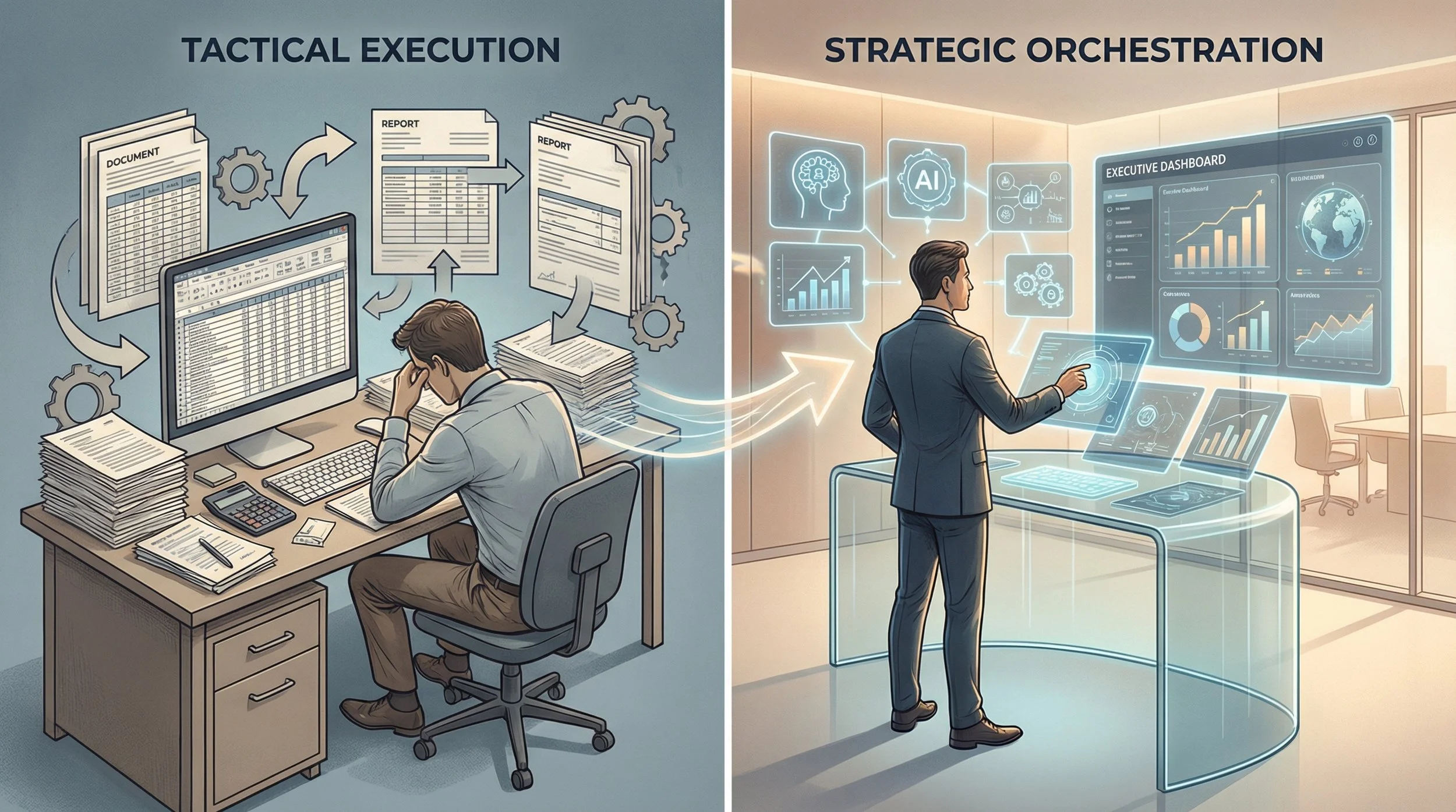
Orchestration
AI can accelerate the journey, but the final decision still belongs to the human analyst navigating the last mile.
A lot of early-career analysts were trained in environments where value came from producing the work manually:
Cleaning data
Building reports
Documenting processes
Capturing requirements
Updating spreadsheets
Turning meetings into artifacts
Much of that work is now being accelerated by AI.
That has led to a myth that junior analysts are becoming obsolete. But that is the wrong read.
AI is not replacing the analyst. It is replacing a category of low-level execution that once sat inside the analyst’s job description.
AI can recommend the route, but human judgment still leads the business forward.
The analyst’s role is moving up the stack.
AI can act as a co-pilot for rote tasks. It can draft. summarize. categorize. compare. forecast. But the human analyst remains the pilot—responsible for judgment, interpretation, stakeholder alignment, accountability, and strategic framing.
This is the difference between automation and orchestration.
And this is where the last mile begins.
What “Last Mile” Actually Means
In business transformation, AI can often get a project 90% of the way there.
It can identify trends. It can surface anomalies. It can generate recommendations. It can map potential next steps. On paper, that sounds like most of the work.
It isn’t.
The final 10% is often the part that determines whether the solution succeeds or fails in the real world. That final stretch requires human context, institutional memory, ethical judgment, emotional intelligence, and practical accountability.
AI can propose a solution.
The Business Analyst decides whether that solution makes sense in the environment where people actually have to live with it.
That is the last mile.
And that is not a minor function. That is the function.
The 3 Pillars of Human-Centric Analysis
The Business Analyst of the AI era does not win by trying to out-machine the machine.
The edge comes from strengthening the human capabilities that AI still cannot fully replicate.
1) Contextual Intelligence
Data reveals patterns, but only human context can turn those patterns into decisions that fit the organization.
Data can tell a team what is happening.
It does not always tell the team what the business actually needs.
A model might reveal inefficiency in a department. A dashboard might show underperformance in a workflow. An AI-generated insight might recommend restructuring, reallocating, or reducing.
But the analyst has to ask what the machine cannot fully know:
What happened in this department six months ago?
Is this team carrying hidden responsibilities not reflected in the data?
Are there political sensitivities around this recommendation?
Does this organization have unwritten rules affecting adoption?
Is the “problem” actually a symptom of something upstream?
This is the gap between what the data says and what the business needs.
The strongest analysts are not just reporting outputs. They are translating reality.
2) Ethical Stewardship and Bias Detection
AI outputs can look polished while still carrying flawed assumptions.
That is why Business Analysts must become active stewards—not passive consumers—of machine-generated insight.
This means red-teaming recommendations before they move into execution.
It means asking:
Is this data representative?
Who is missing from the dataset?
Could historical bias be shaping the recommendation?
What assumptions are embedded in the model logic?
Who benefits from this outcome, and who gets overlooked?
This is not just an ethics conversation. It is an operating-risk conversation.
The analyst also has to make the AI legible to the business.
If stakeholders do not understand how a recommendation was formed, trust breaks down. If trust breaks down, adoption slows. If adoption slows, the value case weakens.
One of the most powerful skills a Business Analyst can develop now is this:
Translate black-box logic into plain-language business understanding.
That skill will age extremely well.
3) Emotional Intelligence in Stakeholder Management
In moments of tension and change, trust is built through people, not dashboards alone.
This is the most underrated differentiator in the analyst role.
AI can generate a recommendation. It cannot manage the room after that recommendation lands.
If the insight points to a restructuring, a budget cut, a role shift, or an unpopular process change, someone has to facilitate that conversation with clarity and maturity.
That someone is often the analyst.
The Business Analyst becomes the bridge between machine intelligence and human response.
That means:
Managing resistance without dismissing it
Explaining change without creating panic
Framing findings without humiliating teams
Building trust when speed creates uncertainty
Stakeholders do not buy into dashboards alone.
They buy into people who can explain what the dashboard means, what it does not mean, and what should happen next.
The BA Toolkit for 2026
The toolkit is evolving. Fast.
The future analyst still needs technical literacy. But the job is no longer just about pulling data and packaging findings. It is about directing, evaluating, and governing machine-assisted workflows.
From SQL to Prompt Engineering
SQL still matters. Structured thinking still matters. Data fluency still matters.
But increasingly, analysts are moving from manually querying everything to directing large language models and intelligent systems to perform analysis tasks faster.
That changes the skill set.
Prompt engineering in a business context is really instruction design. It means knowing how to:
Define the problem clearly
Set constraints
Request useful output structures
Challenge weak responses
Iterate toward decision-grade insight
The point is not to sound clever with prompts.
The point is to get better business outcomes from AI systems.
From Descriptive Reporting to Recommendation Evaluation
Traditional analysis focused heavily on what happened in the past.
Modern AI systems move much further. They forecast. They rank options. They recommend actions.
That means the analyst’s role becomes more evaluative.
The question is no longer only: “What happened?”
It becomes:
Does this recommendation make sense?
Is it feasible operationally?
Does it align with company values?
What are the second-order effects?
What happens if we act on this and the model is wrong?
That is higher-order analysis.
And it is where future-ready analysts will build real market value.
Agentic Orchestration
By 2026, many analysts will not just work with one AI tool. They will coordinate multiple AI agents as digital team members.
One may summarize stakeholder notes.
Another may review process documentation.
Another may surface risks.
Another may draft requirement artifacts.
The Business Analyst becomes the orchestrator of this machine labor.
That means assigning tasks, checking outputs, correcting drift, and auditing quality.
In plain terms: the BA begins managing intelligent workflows, not just completing isolated tasks.
A Practical Example: The Community Alchemy Approach
Machine efficiency matters, but sustainable outcomes require human awareness of real-world barriers and community realities.
Imagine an organization implementing an AI system to improve workforce development outcomes.
The AI analyzes resumes, job openings, keywords, demand signals, and likely placement success. It then produces a highly efficient list of job matches.
At first glance, it looks solid.
But the Business Analyst spots the blind spot.
The AI optimized for keyword alignment and hiring efficiency. It did not account for local transportation barriers, childcare needs, schedule inflexibility, or long-term retention realities inside the community.
So while the recommendations looked efficient in the model, they were weak in real-life durability.
The analyst steps in.
The strategy is adjusted to reflect lived conditions, not just system-visible variables. The result is no longer just fast placement. It becomes sustainable placement.
That is the difference between machine optimization and human-centered success.
That is the last mile in action.
The Cultural Debt of AI
Every new technology creates operational debt if the company adopts the tool faster than it develops the culture to use it responsibly.
AI is doing exactly that in many organizations.
The tools are advancing rapidly. But trust, accountability, language, and governance are lagging behind.
That creates cultural debt.
The Trust Gap
When AI speeds up decision-making, teams can start to feel that decisions are happening to them rather than with them.
That creates friction.
Managers begin to question whether experience still matters. Teams begin to wonder whether nuance is being flattened into automation. Stakeholders may resist not because they hate innovation, but because they do not trust how the innovation is being applied.
The Business Analyst helps close that gap.
The role is not just to move work faster. It is to make sure the organization can absorb the speed without losing cohesion.
The Accountability Problem
When an AI-driven forecast fails, the machine cannot own the fallout.
A system can inform a decision. It cannot take responsibility for one.
This is why human-in-the-loop design matters.
Someone must remain accountable for validating inputs, interpreting outputs, approving action, and monitoring consequences. The Business Analyst often sits right in that accountability chain.
That is not overhead. That is governance.
The New Career Roadmap for Junior BAs
The old version of the junior analyst role was heavily support-driven.
The new version is value-driven.
That means the future Business Analyst must learn to operate in three dimensions:
1. Learn the tools
Understand AI systems, workflow automation, prompting, analytics platforms, and decision-support tools.
2. Learn the business
Understand incentives, strategy, operations, constraints, and how organizations actually function under pressure.
3. Learn the people
Understand trust, resistance, communication, behavior, stakeholder motivations, and the emotional layer of change.
This is where the role is heading.
Not toward lower value.
Toward higher consequence.
The strongest entry-level analysts will not define themselves as data support. They will define themselves as value creators—people who help organizations turn intelligence into outcomes that are practical, ethical, and trusted.
Final Thought
AI can generate answers at scale. The Business Analyst still determines which questions matter most.
AI is a calculator.
The Business Analyst is the mathematician.
The calculator can accelerate the work. It can improve efficiency. It can reduce friction. It can even produce answers at scale.
But the mathematician still decides what problem is worth solving, which assumptions need to be challenged, and whether the answer should be trusted in the first place.
That is the human factor in the AI revolution.
And that is why the Business Analyst still matters—arguably more than ever.
BA Checklist for AI Integrity
Before approving any AI-supported recommendation, ask:
1. Is this data representative of all stakeholders?
Look for blind spots, missing populations, and structural bias.
2. Does this recommendation align with our core company values?
Efficiency without integrity is a liability.
3. Can this machine decision be explained to a non-technical executive in 60 seconds?
If not, it is not ready for the boardroom.
Discussion prompt:
As AI takes over more execution work, which human skill becomes most valuable for the next generation of Business Analysts: context, ethics, or stakeholder trust?
About This Article
This article examines why the Business Analyst role remains critical in the age of artificial intelligence. While AI can automate tasks, the final layer of context, ethics, communication, and accountability still belongs to the human operator.
About RW Beckom
RW Beckom publishes strategy-driven insights on AI, systems thinking, governance, and the future of human-centered business transformation.
Continue reading at rwbeckom.com